Justin Morrow
Customer Success Manager – FactorLab · August 2026
Every summer, crews show up to sites where the temperature climbs past 90, the humidity settles in, and the work doesn’t stop. They keep building. They keep maintaining the infrastructure the rest of us depend on. The heat doesn’t care about the schedule.
And every year, some workers end up hospitalized or worse because the conversation about hydration happened too late, too briefly, or not at all.
We wanted to understand what actually changes in daily planning and work when the weather turns dangerous. So we looked at the data and talked to customers – and we developed a new configuration to help: Smart Hydration Schedule.
What The Data Reveals
We used SmartTagIt to analyze tens of thousands of frontline planning conversations across thousands of worksites. When we compared the peak of summer to the first quarter of the year, the shift was clear.
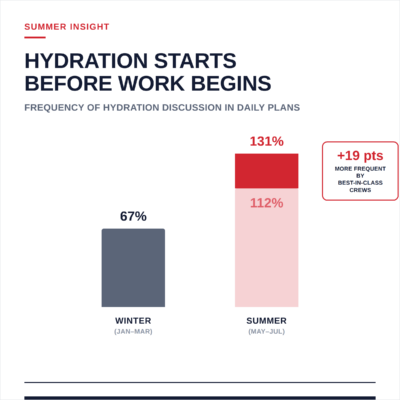
Hydration comes up 67% more often in summer planning conversations than it does during winter months. That makes sense. People know it’s hot. They know it matters. The conversation increases. The question is whether they’re having the kind of conversation that actually prepares people for the conditions they’re about to face.
Best-in-class crews, the top 20%, discuss hydration 19 percentage points more than the average crew. On average, hydration is coming up 1.3 times in planning meetings. They understand that conditions shift depending on the local temperature, the time of day, and the demands of the work, gear and location. They account for the difference between a shaded morning task and direct afternoon sun on a roof deck.
They’re applying the company’s hydration policy, accounting for those specific conditions, and making sure every person on the crew understands what the day demands of their body. They walk through the schedule, the work-rest ratios, and the specific conditions the crew is about to encounter. They make sure every worker knows what to watch for, what to do, and when to speak up.
This is exactly what OSHA outlines in its heat stress guidance. The framework exists. The question is whether it’s actually showing up in the conversation on your job site not just for those best-in-class crews but for everyone. It can be challenging to get right – if the policy is sitting in a binder, if (and when) the weather or activity is changing a lot during the day, it’s not easy to calculate and plan for all the changes. It’s too easy to revert back to a rule of thumb.
Making Hydration Easier to Get Right
We built the Smart Hydration Schedule configuration in SmartTagIt to quickly and easily close the gap between the standing policy and the real conditions a crew faces on a given day.
Here’s how it works. A worker selects AI Assist within a pre-task plan, an existing SmartTagIt activity, or a dedicated heat-stress activity. SmartTagIt uses the company’s heat-stress guidelines, applies the local weather forecast, and generates a recommended hydration schedule and work-rest ratio specific to what that crew is about to encounter.
Crew leaders review that plan and make any necessary adjustments. No interpreting changing weather forecasts on your own. No defaulting to a blanket policy or rule of thumb. Crews get timely, location-specific guidance at the start of every shift.
The goal isn’t to replace the leader’s judgment. It’s to give them a faster, more accurate starting point so the conversation before work begins is grounded in real conditions, not assumptions.
Getting Started with Smart Hydration Schedule
The best crews we see don’t treat hydration as a seasonal add-on. They treat it as part of how work gets planned and led every single day. The data shows it in their conversation rates and their conversation quality.
The conversation before work begins is where heat illness gets prevented. If you want to make the conversation easier, smarter, and grounded in the latest forecast of conditions, reach out to your FactorLab Customer Success Manager to see how the Smart Hydration Schedule can help today.